What to Do While You Wait: An Audition Day Plan
If you've followed Audition Playbook for a little bit (and explored beyond the memes), you've heard me say some version of the same thing about a hundred different ways: just have a plan.
I've said it about your daily practice. Your mock auditions. Your visualization. I've even told you to have a plan for your inner critic (hi, Bob) and the two-week slump. By this point, you probably think I'm a crazy lady who plans her steps from the bed to the coffee pot in the morning. Joke's on you: a robot turns on my espresso machine before I wake up.
But there's one huuuuge part of audition day I haven't written much about: the waiting.
Once I started going into auditions with a plan — how I'd play the excerpts, what I'd eat for breakfast, what time I'd arrive — I realized that all of it simply covered the activated times. Sitting with 40 horn players playing Beethoven 7 up the octave all day and keeping my sanity? No plan for that.
Audition day waiting comes in two flavors: the long, open-ended stretch before your number is up, and the tighter, high-stakes wait once you're on deck. They each need a plan.
Part One: The Long Wait
Know the possible shapes of your day before you arrive
Whether it's an 8am cattle call for all candidates or you're just drawing numbers for your specific block, decide in advance how you might handle pulling #1 or #99.
You could end up onstage in 20 minutes or you could be killing time until dinner. I've been soooo lucky as to experience both, so I go in assuming either is not just possible, but likely.
If you can mentally hold both outcomes loosely, decide ahead of time that you're fine either way, and know what that might look like, you can skip the part where you're standing in the hallway at 8:15am thinking, well, sh*t, now what?!
Flip the switch off
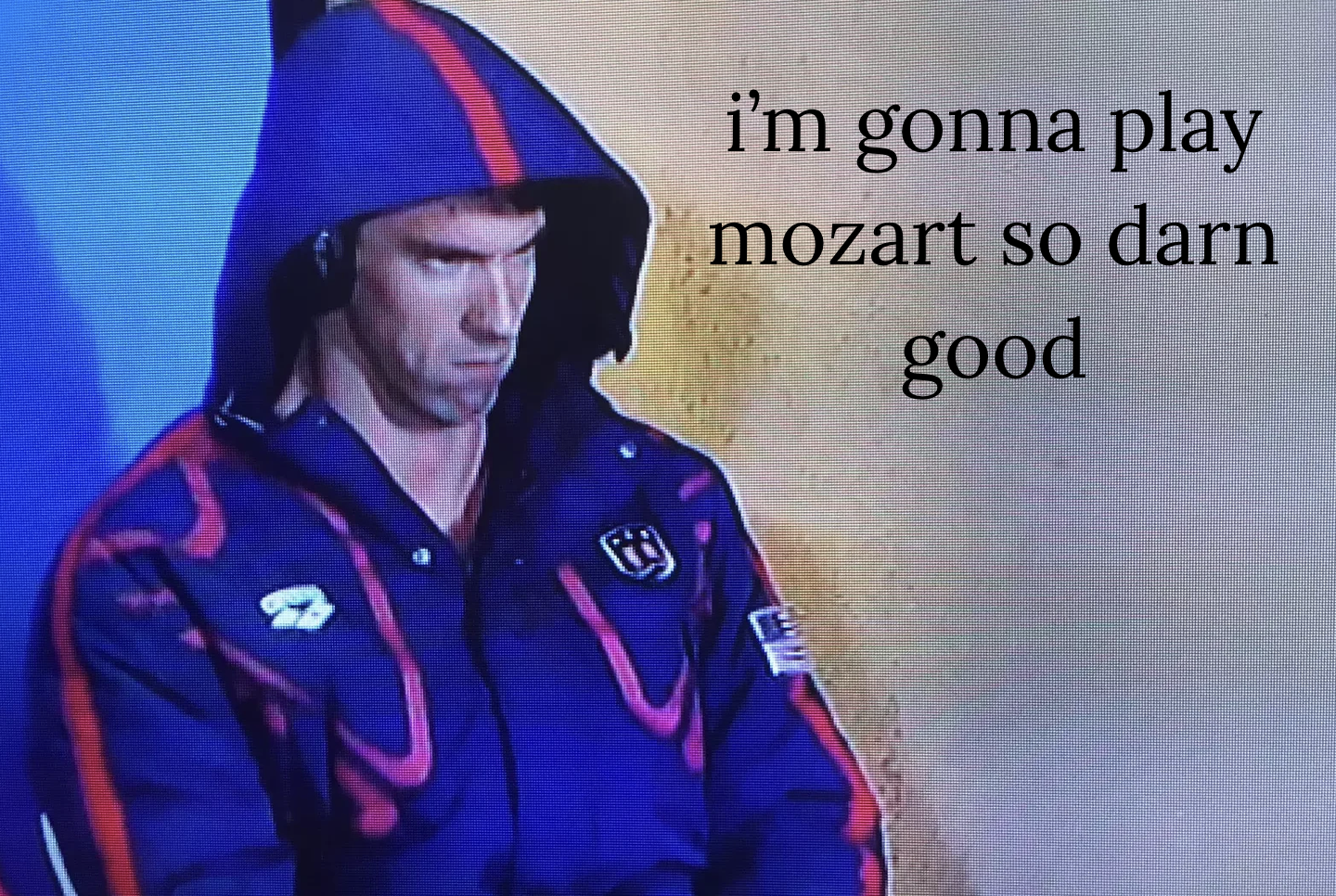
Early in my audition-taking career, I thought the goal was to be locked into Michael Phelps mode from the second I woke up until the second I walked off stage. I was trying to hold peak intensity for twelve hours straight.
But by 11am I was wrecked.
Focus isn't a switch you flip once. It's a dimmer switch you slide up and down, intentionally, all day long. (Think of your dad, constantly coming into each room and turning off the lights you left on — just me?)
If you know you've got three hours to kill between rounds, you're not spending that time watching Rick and Morty for three hours straight, but you're also not white-knuckling it in a hyper-vigilant performance state the entire time either. You're just turning the temperature dial down.
What that looks like for me:
I scope out places to chill before I even need them.
If I know there's a chance I can sneak away from the big holding room, I want to already know my options — a Starbucks nearby, how close my hotel is if I want to retreat there, a quiet spot onsite. Sometimes this isn't possible. Sometimes it is. Either way, I'd rather know in advance than scramble to figure it out mid-audition, even if that just means asking someone who works there.
I bring comforting, distracting materials.
An iPad, a book, a podcast. Something pre-decided that doesn't require a lot of mental or emotional energy. Not the news. Not something dark. Not Instagram. I want my nervous system on a low simmer, not off entirely, and not boiling.
I rely heavily on noise-canceling headphones with rain sounds.
If I listened to music or podcasts all day, I'd get overly keyed up and activated. White noise lets me tune out silly conversations and other people playing, without keeping my brain switched on. I've even just worn earplugs underneath the headphones. Headphones powered on, but with no actual sound playing.
No scrolling and no energy vampire conversations.
If I can't sneak off to my own sanctuary of a spot, I'm not engaging with a big group of colleagues swapping audition war stories. I'm also not getting sucked in the the Instagram scrolling loop.
I decide on my food and water ahead of time.
Once I know roughly how much time I have, before I do anything else with that block of time, I figure out what I'm eating and when. That way I'm not negotiating with myself about a granola bar forty minutes before I play.
I know my "back on" time before I relax into the "off" time.
If I have three hours, I decide right away what time I need to start flipping the switch back on. I write it down or set an alarm. Then I relax.
I check in with myself hourly or periodically.
The hourly check-in
Even during the "off" chunks of the day, I schedule small check-ins, every hour or so, for just five or ten minutes.
In that check-in, I don't necessarily pick up the horn. It depends on where I am and how much time I have. But I'll almost always have my mouthpiece on me, so I can blow through the back of it even without the instrument.
What I always do, regardless, is sit and center, which is really its own form of meditation. I go over my process cue. A little easy blowing and buzzing. Some visualization, starting a few excerpts easily in my head. If I have the horn with me and feel like I need it, I might play a couple of easy notes — but really just to remind myself what free, easy note production feels like.
This is just a quick dip of my toes back into the pool of focus.
Part Two: The On-Deck Wait
Now let's talk about the tricky wait of being on deck, when you're brought to your private room and you might have five minutes or an hour and you have to stay ready.
Having a routine here has really saved me from the what-if spirals.
Before anything, I ask the proctor or runner how much time they think I have. They might not know or it might not be accurate, but it gives me a rough idea of the next stretch. I can gauge if I am I about to get rushed am going to be sitting a while.
After unpacking my stuff and getting situated, I mentally press play on a looping cycle I have already created for myself for the rest of the time I'm in the room.
It's a simple 10-15-minute routine of focus and rest that I execute on repeat from that moment until it's time to go.
For me, that loop looks like this:
Centering and mentally going over my process cue. Taking a few good, focused Centering breaths (a la Don Greene).
Breathing and blowing. Breathing in fully and around, blowing air freely through the back of the mouthpiece. Making sure the air is actually moving the way I want it to without creating excess tension.
Quiet, easy buzzing and playing similar notes on the horn. Just enough to get blood into the lips. (By this point, I've already "warmed up").
Mentally starting each excerpt. I go through the round’s list in my head, starting each excerpt clearly and easily.
Physically starting each excerpt. I am not playing the entire round, just the beginning of each piece, for real, on the horn.
A couple more low notes, just to keep the blood in the chops.
Chill. Horn down. I usually lie on the floor with my feet up (a little Alexander Technique-style rest) because it relaxes my back and neck and lets me come back to the horn without extra tension.
Once the timer goes off, I start over from step one.
The point is that… no matter when they knock, I'm never more than a few minutes removed from having just started an excerpt, physically or mentally. I'm never cold. I'm also never overplayed and over-keyed-up.
From the the second I walk into that room, my noise-canceling headphones go on, playing rain sounds. I keep them on throughout, except when playing. (I also tell the proctor up front: I might have these on when you knock, so just come in anyway if I don't answer.) I don't want to be pulled in any direction by whoever's playing Beethoven 7 up the octave next door. I just want to stay in my zone.
And no matter where I am in the cycle when that knock finally happens, I don't bolt out of the chair.
I take a second to sip water. I empty the horn. I take a few breaths. If I need a couple more notes, I play them. I'm not being obnoxious about it, but I am, on purpose, slowing the car down. Early in my career, the knock would come and I'd bolt for the door like the building was on fire. That energy does not serve you. Slow is a choice, and it's one you're allowed to make.
This loop is mine. Yours will look different.
The specific steps I listed aren't a prescription, they're an example of what my body and brain need to feel ready. What you actually put in your own loop should come out of what works for you. It's wise too to have a long version and a shorter one.
This also isn't something you can build the morning of your audition, or even the night before. The first time you try running a loop like this, it's going to feel clunky and take way longer than you think. Maybe your first full pass is twenty-five minutes when you were hoping for ten. That's normal. That's what mock auditions, or even just a timer at home, are for. Run it, time it, tweak it.
This whole system sets up something I do next that deserves its own space: how I actually treat each individual excerpt once I'm playing it, so a crash-and-burn Beethoven doesn't bleed into my Brahms. That's a separate article and skill, but it starts here, in this room, with this cycle.
Happy Auditioning!