How to Prepare for Multiple Orchestra Auditions at the Same Time
Preparing for a single audition is a big enough project. You have one list, one date (hopefully), and one set of logistics to work out.
Add a second audition a few weeks later and a third the week after that, and the usual approach gets reeeeally complicated reeeeally fast. This is especially true when the auditions are for different positions (like principal vs a section role). And there's just so. much. rep. You can't practice everything every day, and you can't work only on the audition that comes first without letting the others rot.
What you need is a way to decide what deserves your attention today, or this week, and a way to make that decision without rethinking your entire approach every morning.
Here are my tips to figure out what to practice when a lot is on the horizon.
First, draw a timeline.
Before you take a look at the musical requirements of each audition, get crystal clear on the how the dates relate. I recommend you draw (literally draw) this out as a visual timeline:
Draw a line. Mark Today on one end and the last of the upcoming auditions on the other.
Mark each audition date along the way, roughly where it belongs.
Note any big performances or other important dates that happen along the way.
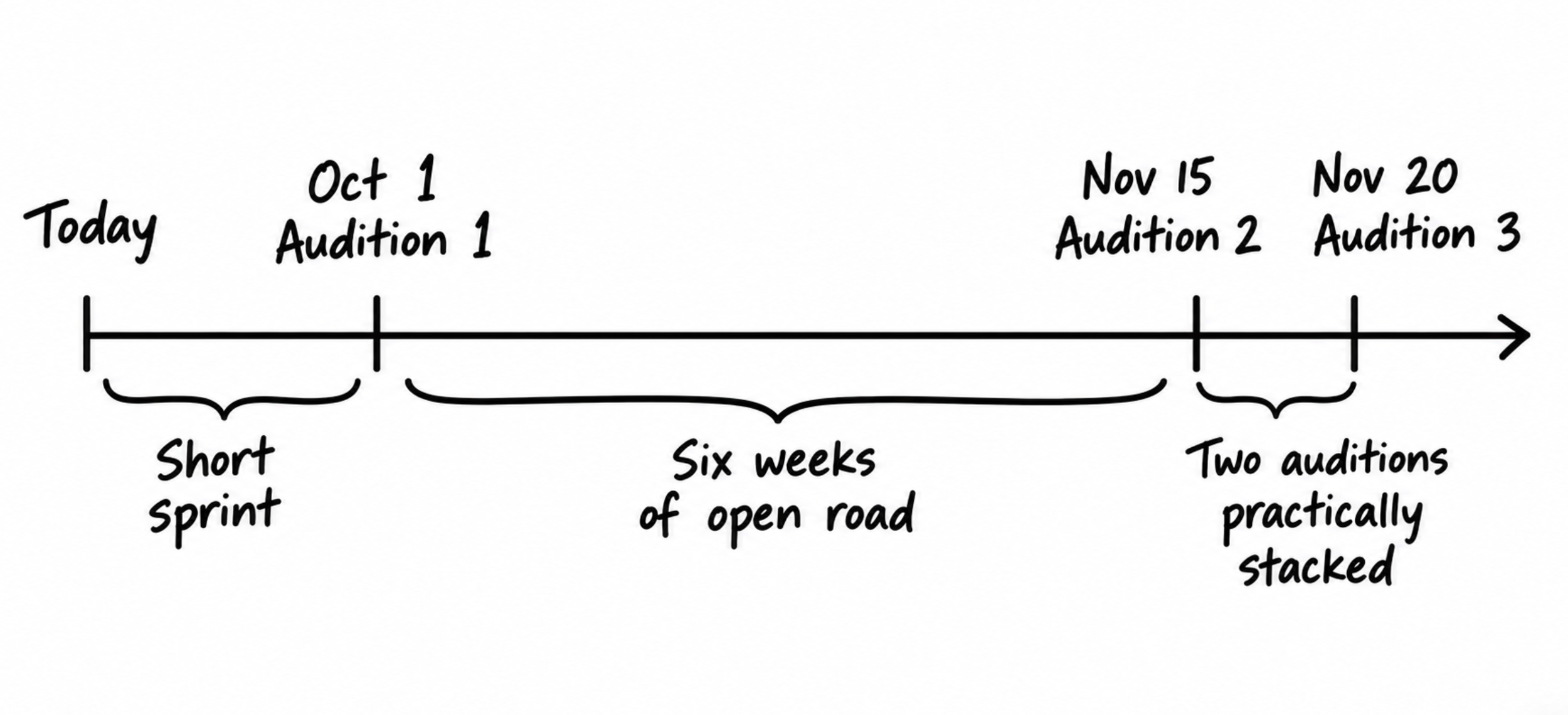
Say you've got auditions on October 1, November 15, and November 20. On a visual timeline, I can new see that as a short sprint, then a six-week stretch of open road, then two dates practically stacked on top of each other.
Instead of seeing this as three prep cycles, I can see one big cycle with two peaks, with the second peak covering two auditions.
Here's what I look for once the line is drawn:
Where the open road is. That long middle stretch is the only place slow work can happen. Range, endurance, a technical weakness that needs weeks to budge, an excerpt I don't really know yet — that stuff goes in the runway, even if its audition is the last one on the line. You can't cram a technical breakthrough in eight days. You can polish an excerpt in eight days.
Where each peak falls. In the last week or two before each date, the work changes character. You stop opening new problems and start running full rounds, performing more than practicing, and ironing out your routines. Anything that still needs building at that point is probably not getting built.
Where two dates share a peak. October 15 and October 20 are five days apart. That means the substantive preparation for both needs to be done before October 15. The days in between are for recovery and maintenance, not for suddenly learning a second list.
Where the ramp back up goes. After September 1, you get a short planned dip to recover and then you're climbing again. Each peak is essentially its own compressed run through the Four Phases, except you re-enter at Core Preparation instead of starting over at Planning. The foundation is already built.
Plan some downtime. There is nothing harder than diving back into audition mode the day after an audition. Give yourself time and space. A spa day, a pizza and Netflix day, whatever you need. But plan it, don't let it snowball into a sustained period of sloth that can derail your progress.
Create one big list.
Use a spreadsheet, yellow legal pad, or whatever you choose, and create one big master list of everything coming up. If an excerpt is an exact duplicate, list it only once.
The point here isn't to practice it all as one giant list. The point is to see it all and be able to assess every piece as part of the bigger holistic picture of your playing and preparation.
Make a three-column grid with the following info:
piece name and measures
which audition(s) it's on
date of first performance (if a piece is on two upcoming auditions, list the date of the first)
assessment rating
When you first see it all together, it will be overwhelming. Three 40-piece lists can be overwhelming. One 120-piece list can seem... horrific. But it's ok, you’ll divide an conquer.
Note: I prefer using something like Google Sheets here as it is easier to sort your list by specific auditions or in order of assessment.
Assess honestly.
Now go down the list and honestly assess every single excerpt as it stands today.
A simple 1–5 rating works fine. 1 means "I've never played this in my life" and 5 means "I could play this for a committee tomorrow and sleep fine tonight."
The key word here is honestly. Don't ask yourself, "Which audition am I most worried about?" That's a feeling. Look at the actual repertoire, excerpt by excerpt, and write down what's true.
You might discover you're 80% ready for the audition three weeks away and 40% ready for the one six weeks away. The calendar alone doesn't tell you what needs work. Your assessment does. With this data, I would spend a lot less time on that closer audition rep, and a lot more on the 40% list. Without it, I would probably front load what feels most pressing on the calendar.
Important: Reassess every week or two. Your readiness changes constantly, so your weighing of practice need should too. Something that was a 2 last week might be a 4 now. Something you thought was a solid 4 might have quietly slipped to a 3 while you weren't looking.
Stop repping Brandenburg. (Focus on fundamentals).
When an excerpt isn't working, the instinct is to play it more. Over and over and over. But rarely is it an excerpt problem. It's a playing problem.
I've spent a decent enough time on the other side of the screen now to say with some confidence: most candidates know the excerpts. It's the holes in their fundamentals that stop them from advancing, let alone winning.
You can tell when someone has put a hundred hours into Ein Heldenleben but hasn't yet figured out how to consistently slur smoothly or get over their embouchure break. The excerpt is prepared but the fundamental playing is not.
So, instead of playing a passage you struggle with a hundred times, maybe ask: What's actually preventing me from playing this?
Maybe it's flexibility. Maybe it's articulation, or finger/tongue coordination, or something else entirely. You KNOW the answer. But what are you doing to fix it? This is part of that honest assessment because once you get really honest about it, you can build exercises around the challenges: études, standards from your routine, or short little exercises you write yourself that zoom in on exactly that one thing. (I call these "excerptcizes" — trademark, me).
Build the skill on its own, then bring the improved skill back to the excerpt.
How does this help with the gigantic list I just created? I feel more overwhelmed now!
There might be 150 excerpts, but there likely aren't 150 fundamental skills on the instrument that you are struggling with.
When you're juggling multiple auditions, ten different excerpts might be falling apart for the same reason. That's not ten problems. It's one problem wearing ten different costumes! Fix the underlying skill and you've made progress on all of them at once.
This is a big part of how I play and teach. In my own practice and with students and coaching clients, I want the majority of instrument-on-face time — usually around 70% — going toward building the fundamentals, not endlessly repeating excerpts. The music itself gets learned largely away from the horn: listening, mental practice, and deciding exactly how you want something to sound before you ever play it.
Plan the week to plan the day.
Here's the problem with everything I've said so far: if you've got three audition lists, you might be looking at 100 or 150 excerpts. Nobody is sitting down every morning to weigh 150 excerpts against each other. You'd spend your whole practice session doing math.
So don't decide daily. Decide weekly, then execute daily.
Once a week, sit down with the master list and the timeline for about 15 minutes and re-assess. In that 15 minutes:
Re-rate anything you worked on. Just the stuff you touched.
Identify the focus of this week. Choose a handful of priority excerpts and technical elements that need increased focus (but not all focus!) this week.
Build in maintenance and rotation. Scan for things you haven’t touched in a while, especially lower-rated pieces, and pull some of those back into the rotation.
Now you’ve got a manageable primary menu for the week.
When you walk into the practice room each day, you aren’t asking, What, out of these 150 things, should I practice today? Most of that thinking has already been done. You’re choosing from this week’s priorities, technical work, and rotation pieces based on the time you have available. You can plug and play the rest, after you tackled the priorities.
How to weigh a “5” two weeks out against a “1” two months out:
The 1 gets the time. It's the one that can still be fixed, and fixing it could take some time, so prioritize any 1's.
The 5 gets a touch: played in full, at tempo, for a recorder or a person, often enough to stay a 5. Which isn't very often.
The rating tells you what needs building and the date tells you when the building has to stop. Anything close and weak is triage: simplify it, make it reliable, and accept that it won't become your best excerpt in ten days.
I built a tool to make this much simpler.

Once I had some semblance of a system for this, I did all of this by hand... spreadsheets, color-coded lists, notes scribbled in the margins of my excerpt books. It worked, mostly. But I felt it could be much more efficient and data-informed.
So I built Practice Room Playbook.
Many years in the making and truly born out of my original Google Sheets versions of the above.
With PRP, you enter your repertoire, rate it, add your audition dates, and it keeps track of what you've played and what's gone quiet. Each day it hands you a prioritized list built on the same three things this whole article is about: how ready something is, how soon you have to play it, and how long it's been sitting. Fundamentals get their own space, separate from the excerpts, so building the player doesn't get crowded out by the list.
Practice Room Playbook launches Tuesday, September 29 and the first 100 paid subscribers lock in a founding member rate for as long as they stay subscribed. To learn more, visit practiceroomplaybook.com.
Is this AI? No, despite the em-dashes, which I've been overusing since the beginning. I do use AI to edit my grammar and organize my thoughts, but I'm not telling ChatGPT to write an article about XYZ and hitting publish. Even with the help, the simplest post here takes me at least one full day and I look like Charlie Day when it's done. A lot of work goes into the free resources on this site, and it isn't cheap to keep running. If it's been useful, please consider the book, the tools, or Practice Room Playbook.