The Mental Shift That Changed Everything in My Auditions
Before we start, I know — that headline sounds like AI* clickbait.
But that title is just... exactly what it was. One shift in my mental game, which took me 10+ years and one devastating audition to find and about thirty seconds to actually do it.
I've wanted to write about this for years but have never sat down to get it all out. Some recent conversations with folks actively on the audition trail have inspired me to share how this came to be.
*And on the subject of AI… I use — and have always used — em-dashes. This is not AI! Em-dashes and Oxford commas 'til the day I die.
Getting Good Wasn't the Problem
By the end of my time at Colburn, I started doing genuinely well in auditions. Advancing regularly, getting to finals. A lot of that progress came from finally having a clear plan, spending a lot of practice time on fundamentals, doing the musical work away from the horn, and trusting the process. I went from a long stretch of not advancing at all to consistently getting pretty far.
I also had the enormous privilege of working with Don Greene at Colburn. We learned centering techniques, visualization, process cues — all of it. I loved it. I built a mental plan for audition day that was just as deliberate as my playing plan.
I had so many tools in the toolkit! And yet...
No matter how diligently I did my centering routine, how carefully I followed the steps, how committed I was to the plan, I always felt like I was in the deep end of the pool with one arm still gripping the edge. I was going through the motions perfectly. I just... didn't fully believe them.

You know that feeling of getting your palm read or watching a stage hypnotist and wanting to suspend disbelief and buy into the stuff, but deep down knowing you can't? It was like that. Every time.
I was doing all of the right things, but there was this other part of me watching. Judging. Narrating. A separate camera lens hovering above, looking down at myself going through the steps and quietly saying, yeah, but is it working though?
Whenever that lens came more into focus and became the show-runner, it was game over.
The Audition That Broke Me Open
I’m going to be candid about a really rough experience I’ve never written about before, because I think the context matters.
In 2022, I had been playing a contract with the Montreal Symphony. That job had been my dream job for over a decade. I loved getting the opportunity over those seasons to play the dream role, even if it wasn't "for real."
The audition for the permanent position came up in June of that year.
Now, if you've ever had to audition for a job you're already playing, you know how uniquely brutal that situation is.
You've grown attached to the livelihood, the colleagues, the routine, the life. You know you can do the job — you've been doing it! And then you have to go prove it in a sterile, artificial environment where the rules of an audition have very little to do with the actual work of being in an orchestra.
I prepared for that audition like it was the Olympics. Fitness routine. Daily yoga. Therapy. Breathing exercises. Visualization sessions. Performance coaching. Lessons. Recording myself. Mock auditions. Meditation. I checked every single box I knew to check.
And I had a death grip on the side of the pool like never before.
Looking back at recordings from the week or two prior to that audition, I can hear it. The anxiety and tightness coming right through the horn. Compare that to recordings from a month earlier? Free, grounded, musical, sounding like me. The grip had already taken over by then and I didn't realize it.
The audition did not go well... at aaaaaall.
What followed was a pretty difficult summer — which, for good measure, also included a sprained ankle and getting COVID while on tour with Montreal in Korea — but the real difficulty was the internal kind.
I had finally experienced the biggest what-if of all: what if I put 100% of everything I have into an audition and it still doesn't work out?
I didn't know what to do. I wasn't sure I even wanted to keep going or even keep playing the horn.
The YOLO Audition
I didn't take another audition for the rest of that year. When I finally decided to throw my name in for something that following January, it was almost impulsive. A last-minute decision after Christmas. I didn't even bring my horn to Florida over the holidays. I just decided to trust whatever capabilities I had and go.
The first round went great. Genuinely great. I had no expectations going in, no death grip, nothing to lose. I just... played.
Then the second round arrived and the old voice showed back up. Oh, this is real now. And it took over almost immediately. Do not pass go.
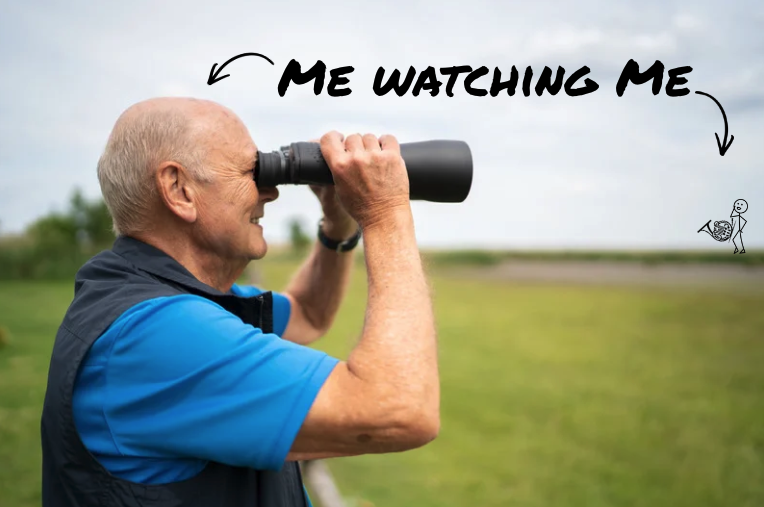
But I felt it happen. I could sense myself splitting into two — the part of me playing, and the part of me watching myself play. I remember sitting in the hotel lobby afterward, writing a reflection, and smiling to myself because I could feel that something had shifted. For the first time, I hadn't just experienced the split — I had watched it happen in real time. I knew what it was and I started to think I might know how to fix it.
The Old Routine (And Why It Wasn't Enough)
At Colburn, I had developed a little half-baked routine for dealing with negative self-talk and doubts. My teacher Andrew called it "Bob on your shoulder." It’s a classic sports psychology idea of personifying the inner critic, acknowledging it, and setting it aside. (I always pictured a little Mucinex tennis ball guy).
That routine looked like this:
Catch a negative thought
Pause and acknowledge it as "just Bob"
Take a centering breath
Remind myself of my process cue or goal for the audition
My process cue (a Don Greene idea) at the time was "breathe low, blow forward, subdivide." A simple anchor that, if I could keep it as my singular goal, tended to let everything else fall into place.
It was a solid system. And it helped... sort of.
But I still watched myself doing it. I'd complete each step and then think, okay, I did the thing. Now what?
And the thoughts would keep coming. And the observer above me would keep observing and judging.
The centering breath didn't close the gap between the part of me performing and the part of me watching. It just gave me something to do while both of them coexisted.
The Switch
OK, so here's the change. It's going to sound stupidly simple.
In the month leading up to the audition that I eventually won — the one for the job I have now — I added one deliberate step to the end of that routine.
After catching the thought, acknowledging Bob, taking the centering breath, and reminding myself of my process cue — I would close my eyes. And I would see myself, from the inside, playing one of the excerpts on the list. Not watching myself from above. Not analyzing or critiquing. Actually inside myself — playing something exceptionally well, with full trust, full breath, full conviction. Doing it exactly the way I intended.
That's it.
No dramatic breakthrough the first time I tried it. No thunderclap. Just a small, quiet flicker of a switch — and something in my brain believed it for a second.
Because that's what visualization from the inside does differently than everything else: it makes the thing real, even if just for a second. It doesn't just tell you to trust — it gives you an experience of trust, however brief.
When I was inside that vision, there was no room for the observer. The other camera lens couldn't exist in the same frame.
I did this constantly. Many times a day. Many times an hour as the audition got closer. I didn't need to visualize an entire round, or even a full excerpt. Just a breath or two of being inside myself, playing something well, grounded and free.
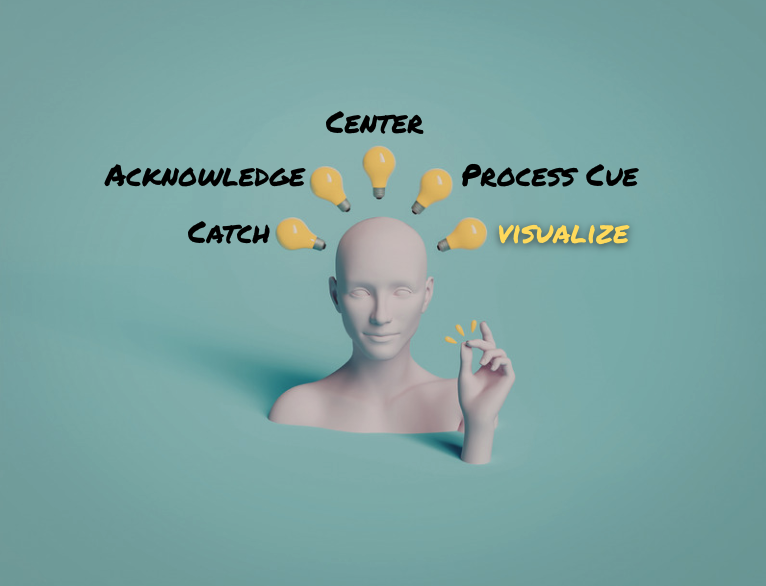
A couple of seconds was enough to flip the switch and bring me back to center... even if it meant I'd have to do it again 20 minutes later.
And here's what I didn't expect: it compounds. Every time you close your eyes and put yourself back inside that vision — even briefly, even imperfectly — you are building a body of evidence that your brain can actually access that place. You've been there before. You know the way. Each repetition makes the next one a little faster, a little easier, a little more believable.
Those seconds of the brain believing... they add up.
By the time audition day arrived, I wasn't trying to conjure something foreign and unfamiliar. I was returning somewhere I'd already been thousands of times.
Staying There
I have a clear memory of sitting in the warm-up room before the final round of that audition.
I caught myself getting excited. Not in a bad way, not catastrophizing. But in that way where you start imagining the positive what-ifs: Oh my god, I could actually win this. Where would I live? What would my life be like?
This always happened in the finals for me and I'd never identified that as a problem before. Distracting, sure. But it just felt like excitement. It felt like confidence, even. Who could fault you for being hopeful in the finals of an audition? I always just let it happen, figured it was natural, maybe even helpful.
But sitting in that warm-up room, I finally recognized it for what it actually was: the exact same shift. The same mechanism. The same external camera quietly sliding back into the driver's seat — just wearing a different coat. Instead of doubt or dread pulling me out of the present, it was hope doing it. The observer was back, and this time it was smiling. But it was still the observer.
That was a genuinely new realization for me. The problem was never just negative self-talk. It was the split itself — any thought, positive or negative, that moved me out of the inside view and back up to the balcony.
And I actually laughed. Because I realized: I have just the tool!
What I Want You to Take From This
I'm not saying visualization is magic. I'm not saying this tool will work the same way for everyone or that it even worked perfectly for me — I still had moments where the observer crept back in.
But for me, the addition of one moment of first-person visualization at the end of an already solid mental routine was the difference between going through the motions and actually believing them. It collapsed the gap between the part of me that was doing the mental work and the part of me that was skeptically watching myself do it.
And — this is important — it applies to both the negative and the positive what-ifs. Getting excited about finals is not the same thing as staying present in finals. Any thought that pulls you out of your singular goal for the day is worth catching, regardless of whether it feels good.
Process cues, centering routines, Bob on the shoulder — all of it still matters. I'm not throwing any of it out. But if you've ever felt like you're going through the mental motions and still holding onto the edge of the pool, try adding this: after whatever your mental routine is, close your eyes for just a second. Be inside yourself. See yourself playing something — one excerpt, one phrase, one note — with full trust and full breath.
Let it be real, even just for a moment.
That moment might be exactly enough.